Japanese-Style Rooms Explained: Tatami Rooms vs. Japanese-Western Rooms
When booking a hotel in Japan, you may notice room types that go beyond standard Western-style bedrooms.
Two of the most distinctive options are tatami rooms (Japanese-style rooms) and Japanese-Western rooms.
Understanding the difference can make a big impact on your comfort—and your overall travel experience.
1. What Is a Tatami Room? What Is a Japanese-Western Room?
A tatami room is a traditional Japanese-style room with woven straw mats on the floor.
Guests remove their shoes and sleep on futons laid out at night.
The atmosphere is calm, minimal, and deeply rooted in Japanese culture—something many travelers want to experience at least once.
Tatami rooms offer an authentic stay, but for those unfamiliar with sleeping on futons, they can feel like a bold first step.
That’s where Japanese-Western rooms come in.
A Japanese-Western room blends the best of both worlds:
tatami flooring and Japanese design elements combined with Western-style beds and modern amenities.
You still enjoy the look and feel of a Japanese room—while sleeping comfortably in a bed.
For first-time visitors to Japan, this hybrid style is often the most comfortable and stress-free option.
2. Tatami Room Highlight: Tokyo Dome Hotel
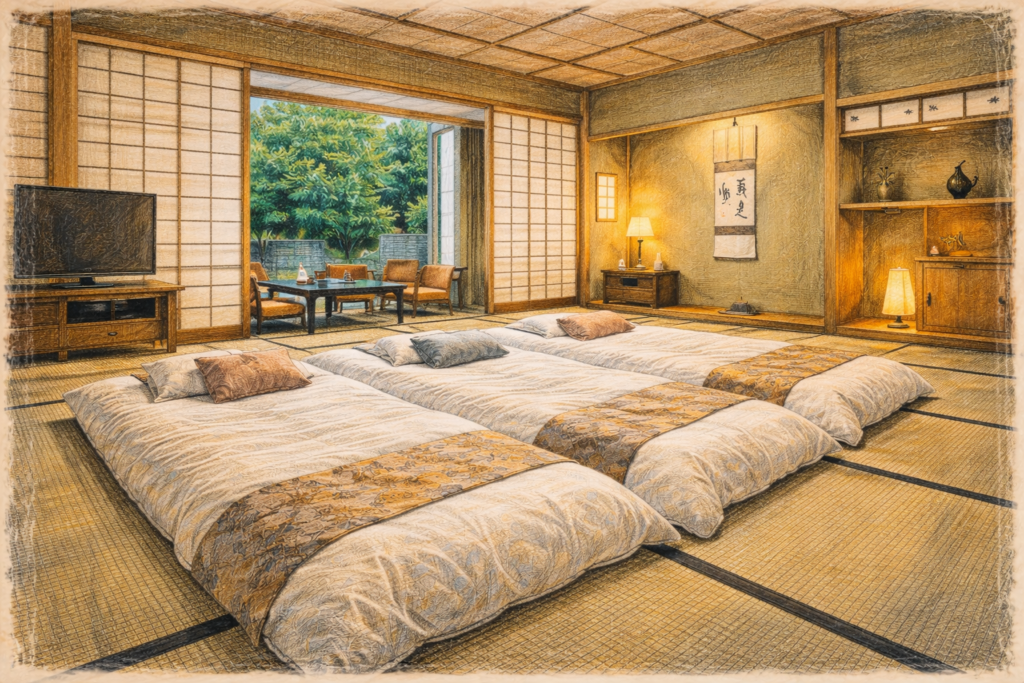
Japanese Family Room (Non-Smoking, 39th Floor)
The Japanese Family Room at Tokyo Dome Hotel offers a rare chance to experience a true tatami room in a modern city hotel.
The spacious tatami layout allows guests to relax barefoot and sleep on futons, creating a stay that feels distinctly Japanese.
Despite its traditional design, the room is located on the 39th floor, offering impressive city views—an unusual and memorable contrast.
This room works especially well for families or groups, and for travelers who want to immerse themselves in Japanese culture without leaving central Tokyo.
3. Japanese-Western Room Highlight: Takanawa Hanakohro
Japanese Garden Suite
Takanawa Hanakohro is known for combining refined Japanese aesthetics with modern luxury, and the Japanese Garden Suite is a perfect example.
The room features tatami flooring along with comfortable beds, making it ideal after long days of sightseeing.
What truly sets it apart is the garden view—especially during cherry blossom season, when soft pink petals frame the windows and create a serene, unforgettable atmosphere.
This room is an excellent choice for travelers who want a distinctly Japanese stay without sacrificing comfort.
4. Final Thoughts: Which Room Type Should You Choose?
If this is your first trip to Japan, a Japanese-Western room is usually the best place to start.
It offers cultural atmosphere, comfort, and familiarity—without uncertainty.
For a second visit (or for travelers eager to go deeper), trying a traditional tatami room can be a rewarding experience that adds another layer to your understanding of Japan.
Whichever you choose, both room types offer something uniquely Japanese—and can turn your hotel stay into a memorable part of the journey, not just a place to sleep.